
documentation
Net Peptide Content vs Purity: What A COA Really Tells You
Net peptide content is the share of a peptide powder's weight that is actually peptide; the rest is counterions, water and salts. How it differs from HPLC purity and what to check on a COA.
- Lavi MD
- November 25, 2026
- 3 min read
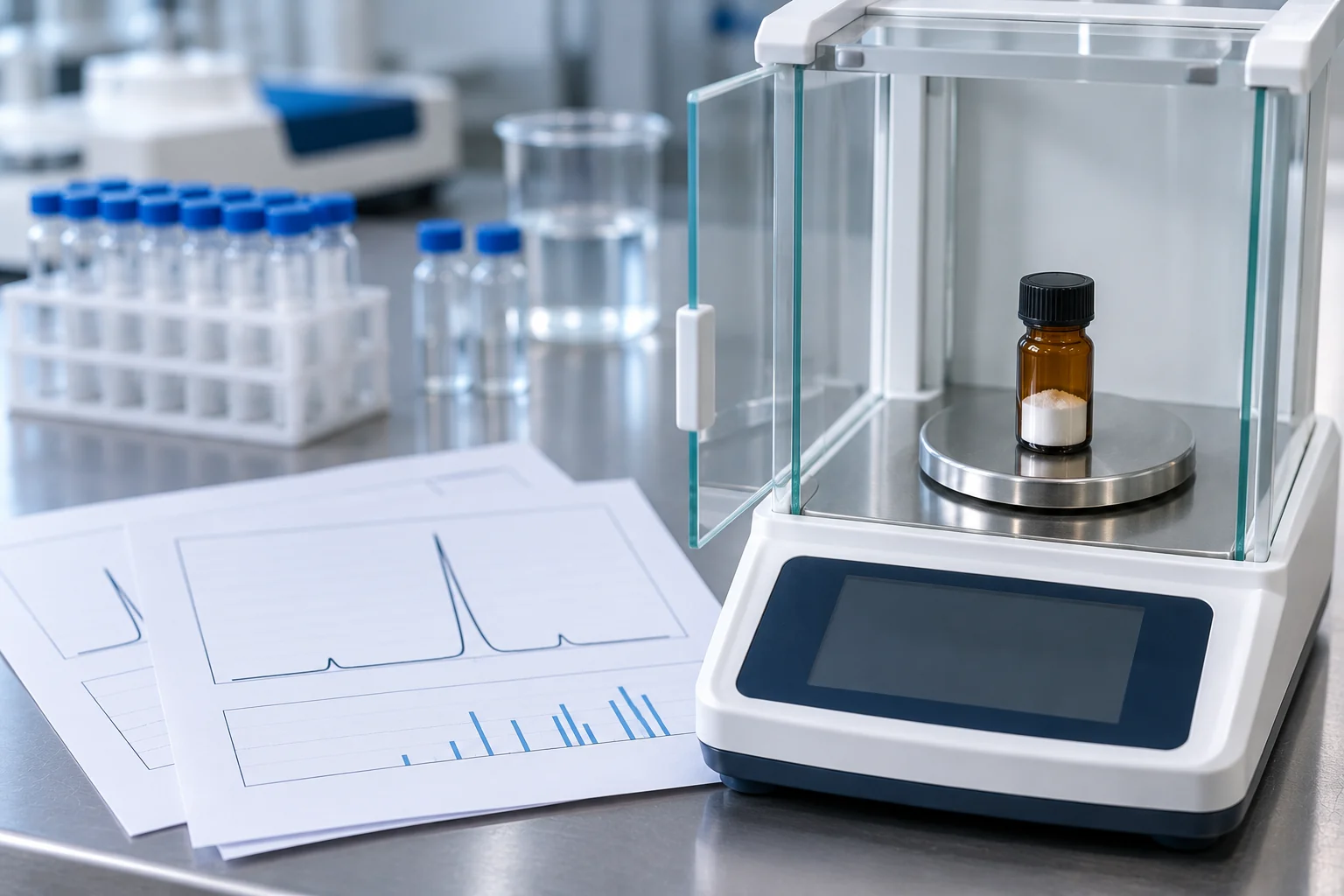
Net peptide content is the percentage of a peptide powder's total weight that is actually the peptide. The rest of the weight is counterions from synthesis and purification (often trifluoroacetate or acetate), bound water and small amounts of residual salts. It is a different number from HPLC purity, and a certificate of analysis can show a high purity and a much lower net peptide content at the same time.
For wholesale buyers comparing suppliers, knowing which number is which avoids a common misunderstanding about how much peptide is really in a vial. This is a documentation guide only. It makes no claims about use.
Net peptide content vs HPLC purity
| HPLC purity | Net peptide content | |
|---|---|---|
| Question it answers | Of the peptide material, how much is the target sequence? | Of the total powder weight, how much is peptide at all? |
| What it ignores | Water, counterions and salts (they do not show as peptide peaks) | Whether the peptide present is the right sequence |
| Typical method | High performance liquid chromatography | Amino acid analysis or nitrogen (elemental) analysis |
Our guide to HPLC purity covers the first column in detail. The short version: purity tells you how clean the peptide is, net peptide content tells you how much of the weight is peptide. You need both to understand a lot.
Why the powder is not 100% peptide
Most research peptides are made by solid phase peptide synthesis and purified by reverse phase HPLC. A 2025 study from ETH Zurich in Pharmaceuticals explains that this process relies on trifluoroacetic acid as a cleavage agent and ion pairing reagent, so peptides are obtained as TFA salts. Those counterions add weight to the powder without being peptide. The same study exchanged the TFA counterion for chloride and found no impact on peptide purity, which shows that counterion content and purity are separate measurements.
Lyophilized powders also hold some bound water, even when dry to the eye. Our page on lyophilized peptides covers how freeze drying works.
What this means for the label amount
When a vial is labeled with a peptide amount, it matters whether that figure refers to the total powder weight or to net peptide. Two suppliers can sell vials with the same label figure and different amounts of actual peptide. Ask:
- Does the label amount refer to gross powder weight or net peptide content?
- Is net peptide content reported on the COA, and by which method?
- Which counterion is present (TFA, acetate, chloride)?
- Is the water content reported?
Reading it on a COA
A complete certificate of analysis for a peptide lot shows identity (usually mass spectrometry), HPLC purity, and, where tested, net peptide content and water content. If net peptide content is not reported, the COA tells you how clean the peptide is but not how much of the powder it makes up. Our peptide COA guide walks through each section.
Documentation at Lavi MD
Lavi MD Wholesale supplies peptides to qualified wholesale buyers with lot documentation on the COA page. If you need to know whether a product's label amount is gross or net, or which counterion it carries, ask us before you order and we will point you to the documentation for that lot. Browse the catalog on the products page. For research and wholesale purposes only.