
coa
Peptide COA: What A Certificate Of Analysis Shows
What a peptide COA should include, how identity (mass spectrometry) and purity (HPLC) are shown, endotoxin testing, red flags, and what to ask a supplier.
- Lavi MD
- November 20, 2026
- 3 min read
What Is A Peptide COA?
A peptide COA, or certificate of analysis, is the lab report that shows what is actually in a specific batch of peptide: its identity, its purity, and the other tests the batch passed. A certificate of analysis is a formal document prepared by a laboratory that details the results of its analyses, signed by an authorized representative of the lab. For a wholesale buyer, it is the document that ties the vial in your hand to a tested batch.
This article sets out what a peptide COA should contain, what each analytical section reports, and the documentation questions to raise with a supplier.
What A Peptide COA Should Include
- Product name and batch or lot number. The lot on the COA must match the lot on the label. A COA without a lot number tells you nothing about the vial in front of you.
- Testing laboratory. Who ran the tests, and whether they are independent of the manufacturer.
- Test date and signature. When the batch was analyzed and who signed off.
- Identity. Confirmation that the molecule is the peptide named on the label.
- Purity. The percentage of the sample that is the target peptide.
- Additional tests where relevant. Such as endotoxin, sterility or residual solvent results, depending on the product format.
How Identity Is Usually Shown: Mass Spectrometry
Mass spectrometry measures the mass to charge ratio of ions, which is used to determine the masses of molecules and confirm their identity. On a peptide COA, look for the measured mass next to the expected mass for that peptide. They should match closely.
How Purity Is Usually Shown: HPLC
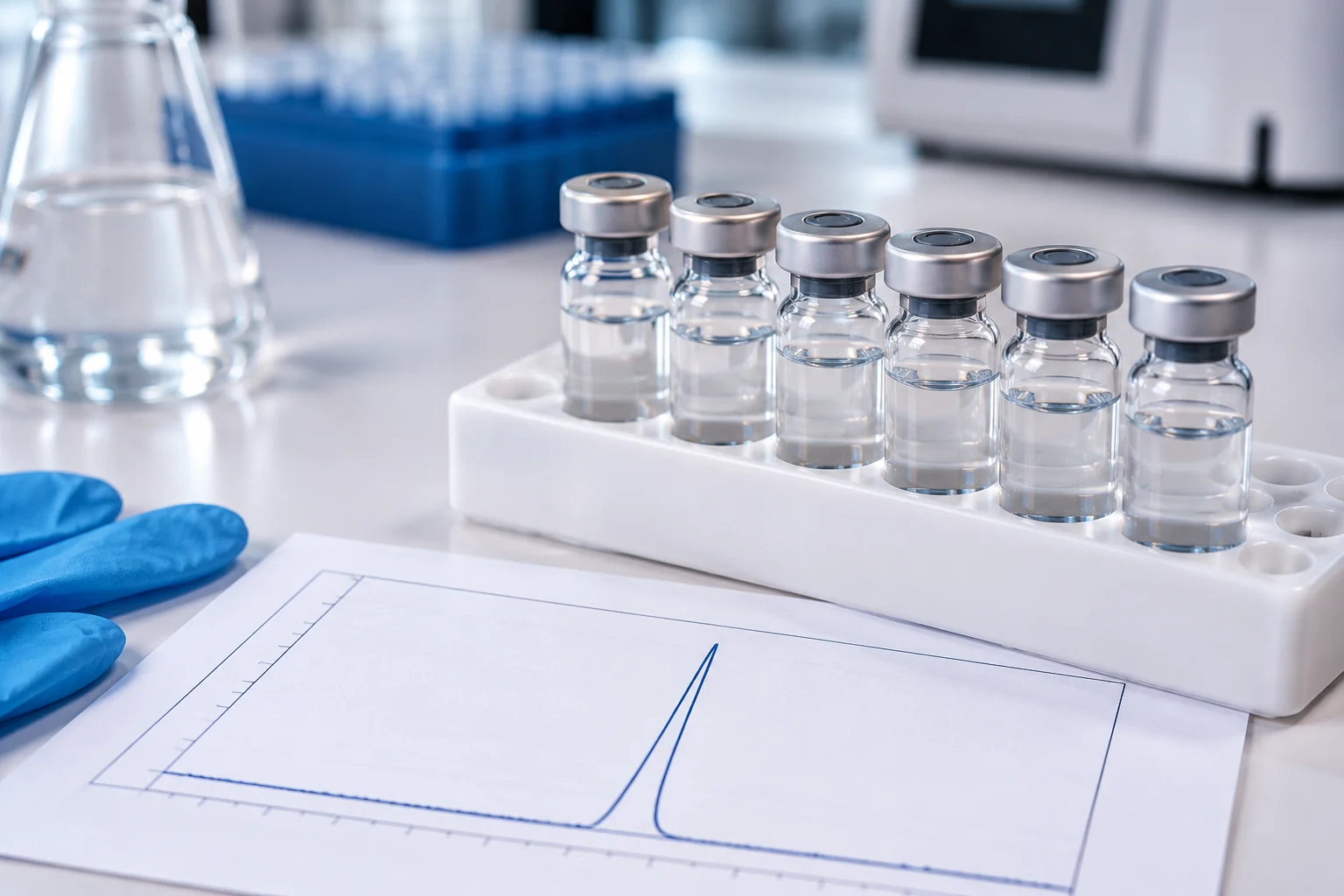
High performance liquid chromatography, or HPLC, is an analytical technique used to separate, identify and quantify the components of a mixture. On a peptide COA it typically appears as a chromatogram with one main peak for the peptide, and a purity percentage. Smaller peaks are other components in the sample.
Endotoxin Testing
Endotoxin is another name for lipopolysaccharide, a component of the outer membrane of certain bacteria such as E. coli. A complete COA states whether the batch was tested for endotoxin, the method used and the result.
Red Flags On A COA
- No lot number, or a lot number that does not match the label.
- No laboratory name or contact details.
- A COA reused across many different batches or products.
- Results with no method listed (no HPLC, no mass spectrometry).
- An unsigned or undated report.
Questions To Ask Your Supplier
- Can I see the COA for the exact lot I am ordering?
- Which laboratory ran the tests, and is it independent?
- Which methods were used for identity and purity?
- Was the batch tested for endotoxin where relevant?
- How is the product stored and shipped to protect it?
COAs At Lavi MD Wholesale
Lavi MD supplies licensed wholesale accounts only. Every batch is documented, COAs are available on request, and products ship cold chain. Lab reports are published on our certificates of analysis page as they are released. Browse all products, including TB-500, Thymosin Alpha-1, NAD+ Injectable and our nasal sprays, or contact us to request the COA for a specific lot. Our wholesale buyer guide to peptide therapeutics has more on sourcing and storage.
This article is general information for licensed wholesale buyers. It is not medical advice and makes no claims about the use or effects of any product.